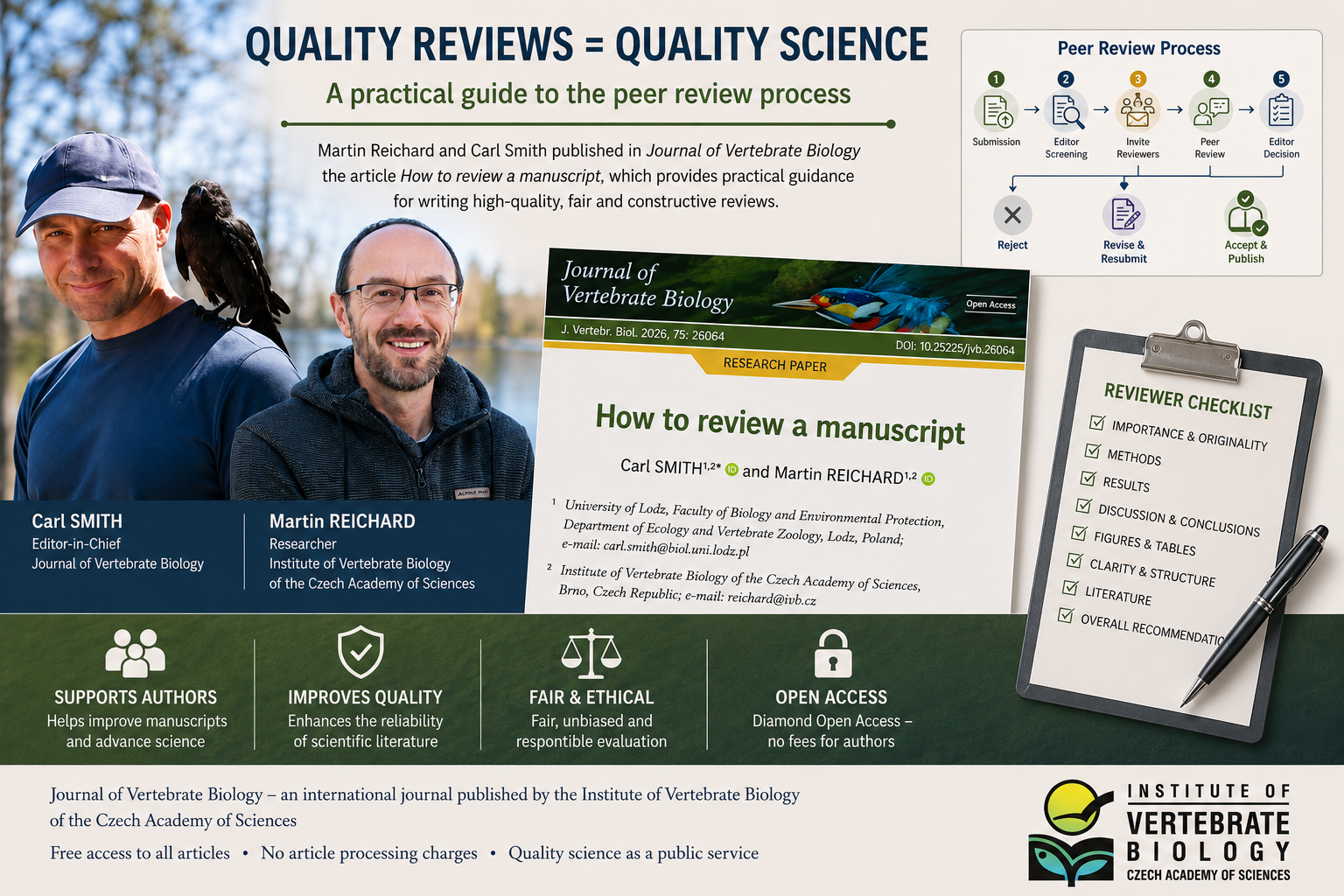
Peer review is a cornerstone of modern science. Through independent evaluation by experts, new scientific findings undergo critical scrutiny before entering the scientific literature. Yet most researchers learn to review manuscripts through trial and error, and relatively few receive formal training in how to write a high-quality, objective and constructive review. To help bridge this gap, Carl Smith and Martin Reichard have published the article How to Review a Manuscript in the Journal of Vertebrate Biology.
Both authors are internationally recognised experts in evolutionary ecology and zoology. Between them, they have published hundreds of scientific papers, accumulated thousands of citations, and gained extensive experience as authors, reviewers and editors of international scientific journals. In their new article, they summarise best practices that can help both early-career and experienced researchers produce higher-quality reviews and contribute to improving the overall standard of scientific publishing.
The article guides readers through every stage of the peer-review process, from deciding whether to accept a review invitation, through the systematic evaluation of each section of a manuscript, to writing clear, professional, and constructive feedback. It also discusses the ethical aspects of peer review, the principles of open science, and the most common mistakes reviewers make. A practical reviewer checklist is included as a useful reference when assessing any scientific manuscript.
“Most researchers learn how to review manuscripts by trial and error. Yet writing a good review is a skill that can be developed, just like scientific writing itself. We wanted to provide practical guidance that will help, especially early-career researchers, feel more confident when reviewing manuscripts for the first time,” says Martin Reichard, co-author of the article and a researcher at the Institute of Vertebrate Biology of the Czech Academy of Sciences.
According to Reichard, the role of a reviewer is not to find faults at all costs, but to help authors produce the best possible scientific work.
“A good review is not simply a list of criticisms. It is expert feedback that helps authors improve their manuscript while simultaneously strengthening the quality of the scientific literature as a whole,” he adds.
The importance of high-quality peer review has long been a priority of the Journal of Vertebrate Biology, the international scientific journal published by the Institute of Vertebrate Biology of the Czech Academy of Sciences. The journal continues the tradition of Folia Zoologica, first established in 1938, and today publishes research in zoology, ecology, evolutionary biology and vertebrate conservation.
Under the leadership of Editor-in-Chief Carl Smith, the journal has undergone extensive modernisation and now adheres to the principles of Diamond Open Access. This means that all articles are freely available to readers, while authors pay no publication charges. The model is made possible by the long-term support of the Institute of Vertebrate Biology, which considers high-quality scientific publishing an important public service.
“Our goal has been to create a journal where publishing is as fast and author-friendly as possible while maintaining rigorous peer review. Thanks to support from the Institute of Vertebrate Biology, we can now offer something almost unique: complete open access to all articles and publication free of charge for authors,” says Carl Smith, Editor-in-Chief of the Journal of Vertebrate Biology.
For Smith, the quality of the peer-review process is as important as open access itself.
“A good journal depends not only on excellent papers but also on excellent reviewers. Fast, expert, and constructive reviews benefit authors, editors, and the scientific community alike. That is why we decided to share our experience in the form of a practical guide,” he concludes.
The new article is therefore more than a guide for reviewers. It is also a reminder that high-quality peer review remains one of the most important components of the scientific process. Fair, rigorous and constructive evaluation improves the quality of published research, strengthens confidence in science, and supports the development of the scientific community as a whole.
Publication
Smith, C. & Reichard, M. (2026). How to Review a Manuscript. Journal of Vertebrate Biology.
DOI: 10.25225/jvb.26064